Friday, May 31, 2013

A bit of advice

There's something about groups of three. Triplets, trinities and triptychs strike a chord at the very deepest level of thought. (Also troikas and tricycles, but that would make a list of five, which doesn't work nearly so well. Though you should never forget the rule of five.)

Having briefly covered reading, writing and 'rithmetic in the previous post I thought I'd start this one off with another popular triple: fear, uncertainty and doubt.

When you are uncertain how to handle a situation and doubt your ability to succeed in it, it is only natural to fear and avoid the situation itself. For example...

I have been afraid of fitting curtain rails for more than thirty years. I read the do-it yourself guides and the instructions are clear. You mark your target and drill into the concrete lintel using a hammer drill and masonry bit. Perhaps there's something wrong with my masonry bit. Whenever I try, I make no impression at all on the lintel. Though I make a tremendous impression on the (usually ageing) plaster, shaking it to dust for about an inch all round the drill. My curtains are, at best, precarious.

So it was more in sorrow than in anger that I heard the Beloved cry out in alarm from the bedroom window. Like a disreputable politician draped in the Flag, I found her draped in the curtain. So there was nothing for it but to hie me to B&Q, acquire the fixings and a new curtain pole and follow Henry V once more into the breach.

More in desperate hope than expectation, I tried something a little different this time. And, just for once, it worked. Like a charm. So here is my bit (geddit?) of advice:
If you are getting nowhere with a masonry bit, try a High Speed Steel bit. (And switch off the hammer action.)
I don't seriously believe that my houses have all had RSJs over their windows. But they have all been over 100 years old, and perhaps in that time the concrete has hardened to a texture more like steel than brick.

It only took me something over 30 years to find this out.

There are plenty of other things I have been putting off because my tools and methods don't seem to work. I feel inspired: where to begin?

Early education: striking the balance

Too much reading

Or at least, browsing. Time to cut back on Facebook and Google+. (I'm not giving up "Bring Up the Bodies". So there.)

Not enough writing

Made a start. 'Nuff said.

Not enough 'rithmetic

Time for a cold look at the numbers. It's always wise to keep an eye on them, before they go scampering off somewhere naughty. Those little scampering scamps.

Clutching at money

It's the little things that get you...

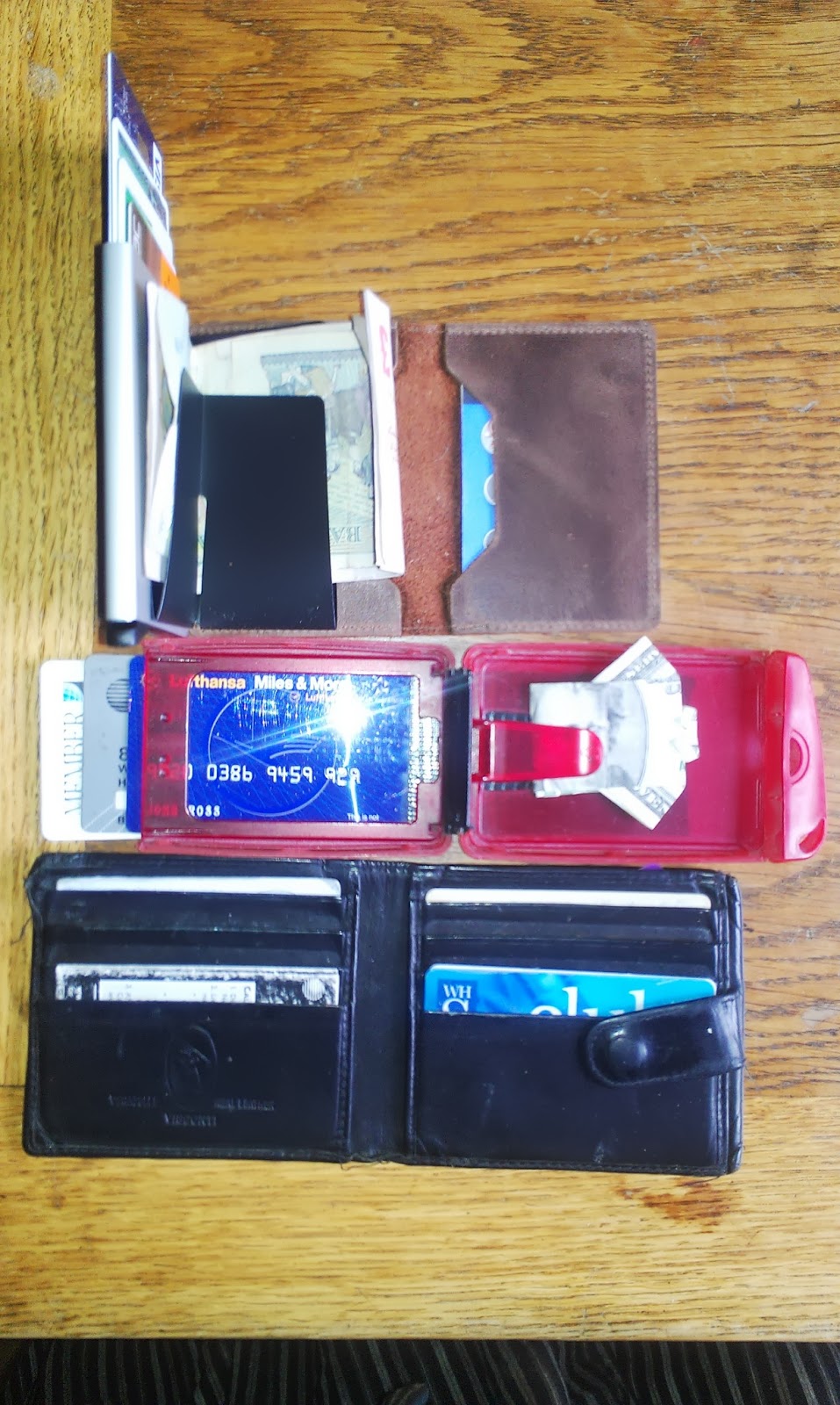
I have loved a succession of Jimi wallets. These neat plastic cases hold five credit cards and four folded notes (three if you're American). Not just a wallet, but a minimalist philosophy of life.

BUT... folding notes takes just a little too long. It takes one more hand than I have conveniently available. It distracts me just a little too much from the transaction. On the other hand, the nice little snap-open plastic wallet often piques the interest of a bored sales assistant, starting a conversation and shining just a little light into a humdrum day.

My latest Jimi has come to the end of its life. They only last a couple of years. What to do? Replace it with another? Grow up and get a standard bloated leather wallet just like everyone else's?

or...

When the Dutch aren't officiously sailing up the Medway and burning our fleet, they occasionally get quite creative. One thinks of the great master painters... the "good morning" mug... Schiphol airport... serious hydro engineering. And now, the secrid card holder/ wallet.

This ticks all the boxes: quirky, minimalist and takes notes without folding. And for bonus points, it prevents unwanted interference with your RFID cards. A tin-foil hat for your credit cards. Costs rather less than an expensive wallet but a lot more than a cheap one.

It arrived yesterday. I'm eagerly awaiting an excuse to take it shopping.

Now, about those Martians...

Tuesday, May 28, 2013

Not Waving But Rolling

Marketing guru and general brain box Seth Godin did two pieces a month or so ago on the subject of "picking yourself". The point being that it is an increasingly risky strategy to try and get someone else to pick you for a key job. Your pitch is drowned out by millions of others, and the key people actually have less power now to help you. Good stuff, and well worth a read.

But he finished off with the snide jibe: "the Grateful Dead or the Bay City Rollers?".
Oi!
myaccount@gmail.com


Let me add my small voice to the avalanche of outrage at your sneer at Scotland's premier boy band.
Especially as they actually illustrate your advice rather well. They picked themselves and spent five years building up their local following before they were ever seen by Tam Paton. And if they hadn't been picked, there is no reason to believe that they wouldn't have carried on as semi pro musicians entertaining the locals for many years. Which I would consider a success.
Of course, the phenomenon of Rollermania was more about clever marketing than music. And that was very actively planned and executed. And had very little to do with the band.
Or was that your point: that when you're picked you become someone else's product?

If so, I apologise for being dense.
Regards,
Will Ross
It's always as well to check your facts before you enter the fray. My intensive researches on Wikipedia confirmed my memory of seeing Bay City Rollers  on the walls of the South Side of Edinburgh well before they shot to fame on Top of the Pops with their tartan accoutrements and general Scottishness. Imagine my delight when I also discovered that the Longmuir brothers started out in 1966 as Saxon. Having suffered throughout my school years as a Sassenach I feel a Mystic Bond.

The name apparently came from Bay City, known for its rolling waves, or Bay City Rollers. And indeed, the wave of pop history rolled on leaving the boys high and dry.

The last word must of course go to Godin. He summed up the aching pointlessness of getting picked for a ride in the locomotive of someone else's gravy train:


Seth Godin May 1
to: me
alas, you were the only one


Saturday, January 19, 2013

The right notes in the right order

Spotify very kindly suggested that I might like these chaps. Spotify knows me too well. Just give me a tune with all the notes in the right order at exactly the right time, and I’ll be happy… Is that too much to ask? Evidently not.

Friday, December 7, 2012

Towards a moral calculus

Notorious Atheist Sam Harris makes the case for applying scientific methods to questions of morality. So far as I can make out, his core arguments are:

  1. human wellbeing is a meaningful, objective concept
  2. if you pick any two responses to a particular moral dimension, you can in theory (if not in practice) scientifically assess which is going to lead to more human wellbeing.
  3. we have a duty to maximise human wellbeing throughout the world
  4. therefore we should challenge suboptimal choices in our own and in other societies
  5. in particular, we should not abdicate the concept of morality to religion, but should consider it scientifically.

All good stuff and hard to argue. He illustrates his talk with side swipes at a number of practices which he considers religiously motivated. These are less convincing, but should not distract from his core message.

He implies that we can determine a single metric for human well-being which can be assessed. This is where I lose him. It seems to me that there are a number of dimensions to consider. We can generally agree on which of each of the following is better:

  • freedom – slavery
  • sickness – health
  • life – death
  • a life of passive acceptance – a life of meaningful contribution
  • respect – contempt
  • safety – danger
  • scarcity – abundance
  • construction – destruction
  • pain – pleasure

We can probably resolve these into a limited number of independent dimensions. If there are is more than one dimension, then the best we can hope for from science is that it can show us how to get to the envelope where increasing one dimension requires a trade-off in another. At that point, any further change requires a value judgement as to which dimensions we consider most important. Science cannot help us with this.

It is also not as obvious as it may appear that any society is actually far from the envelope already. In any case, to assess this, we need to identify a robust set of rigorously defined set of dimensions of well-being and models showing how they are constrained. Then we can sensibly discuss individual cases and value judgements.

This is so obvious that it must have been done, or at least worked on, already. Presumably Mr Harris can point me in the right direction?

Thursday, October 11, 2012

Rule of Five

Right: enough of the whippersnapper Kipling. I think you’re ready for some ancient wisdom: how to understand the essence.
The alchemists had a number of techniques. Perhaps the simplest was to boil off the spirit and distil it. Then take the distillate, boil off the spirit and distil it. Then repeat. And repeat. And repeat. By which time you should have got to something pretty pure. the five times distilled “quintessence”. 
Swooping back to the present, Nicholas Bate's series on "Simplicity, the far side of complexity" rolls on. Episode four is "Dig Deep: Find The Real Issue". But how deep? Bate offers "Deeper", with the implication that you'll know when you've gone far enough.
Slithering back a couple of decades, let me offer a tip I got from Shoji Shiba, the TQM guru, in the early 90s. He recommends that, however well you think you understand a question, you will always understand it better if you go down five levels.
1. Why didn't I get the management team to sponsor my project?
    A. Because the presentation was poorly prepared
2. Why was the presentation poorly prepared?
    A. Because I did it in a rush the day before
3. Why did I do it in a rush the day before?
    A. Because I was too tired to make time amongst all my other priorities until I had no option
4. Why was I so tired?
    A. Because I stay up late browsing social media late into the night
5. Why do I stay up late browsing social media?
    A. Because I don't feel I've achieved anything worthwhile during the day
This is a trivial example. As often as not, round about the fourth question, you break through a bland, conventional explanation to get down into the root of a problem, or make a lateral link that gives a new and useful insight.
This is very much Mother Nature's learning strategy, as any parent of a small child will recognise. Can a million years of evolution be wrong?
Perhaps it should be "The Rule of Five Year Olds"?
Try it: it costs nothing to release your inner toddler!

5 More 5s

  1. Pentagrams: getting ready to celebrate the feast of All Souls?
  2. The Five Marks of Mission: the CofE has always been corporate. Whilst I wouldn’t normally recommend a five part mission statement, theirs is worth five minutes’ contemplation. Would Jesus have allowed weasel words like “seek to” and “strive to”? Still, a good effort, I think. Having read it, how does yours stack up?
  3. Five honest serving men: Any of the five Ws from Kipling’s six will each guide you faithfully down to the next level of insight. I had forgotten that he rested them during working hours. Times have changed.
  4. Five steps to a project: David Allen’s Natural Planning Model will bring focus and purpose to any task. Requires: the back of an envelope, a pencil and five minutes.
  5. Quintessence